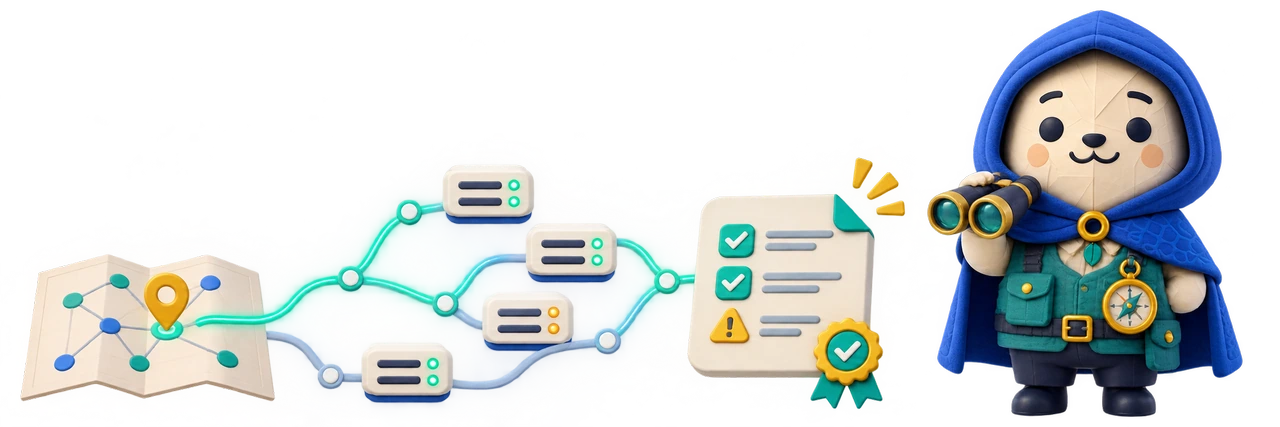
Scout separates an endpoint being listed somewhere from an endpoint being checked for a particular use at a particular time.
A public proxy list is a collection of claims. Addresses repeat, country labels may be inaccurate and a proxy that responded earlier may fail now. More rows do not resolve those problems. A useful result needs a clear identity, check time and evidence about the behavior tested.
Scout is a Python-first project for making that process repeatable. Its architecture separates collection, normalization, checking, country resolution and export from the interface shell. The goal is to explain where an endpoint came from, why it passed or failed and whether the result suits the intended task.
What it is designed to do
The capabilities, in detail.
Replace an opaque list of proxy addresses with a repeatable collection, verification and filtering workflow that can be measured.
Collect through a configurable source registry
The direction supports reusable strategies for text, HTML, JSON and paginated sources, with isolated handlers for unusual formats. Separate source definitions reduce duplicated scraper code. Source records give failures and quality observations somewhere to belong instead of leaving the collector with an unexplained empty list.
Normalize without losing provenance
Several sources may describe the same host and port differently. Scout's architecture calls for canonical endpoint identity and deduplication while retaining all contributing sources. That makes a shorter result list more informative: a candidate can be traced to its origins rather than appearing as an address with no collection history.
Check explicit behavior
Protocol, liveness, latency, anonymity and failure reasons belong to the proposed verification model. Timeouts, refused connections and invalid responses should be distinguishable outcomes. Performance and reliability claims need representative measurements; an implementation containing a checker is not evidence that every check is complete or that Scout outperforms alternatives.
Treat country labels as evidence to resolve
A source-provided country label is a hint rather than an authority. The architecture uses local CIDR matching as the final country check, with filtering built around normalized results. Country assignment still depends on the underlying data and its freshness; it should not be presented as a guaranteed statement about an operator's location.
Keep runs understandable and recoverable
Pause, resume, cancellation, checkpoints and CSV, TXT and JSON export are documented workflow targets. A versioned run record would allow completed work and failures to be distinguished after interruption. The application core remains separate from the desktop bridge so interface changes do not need to redefine collection or verification logic.
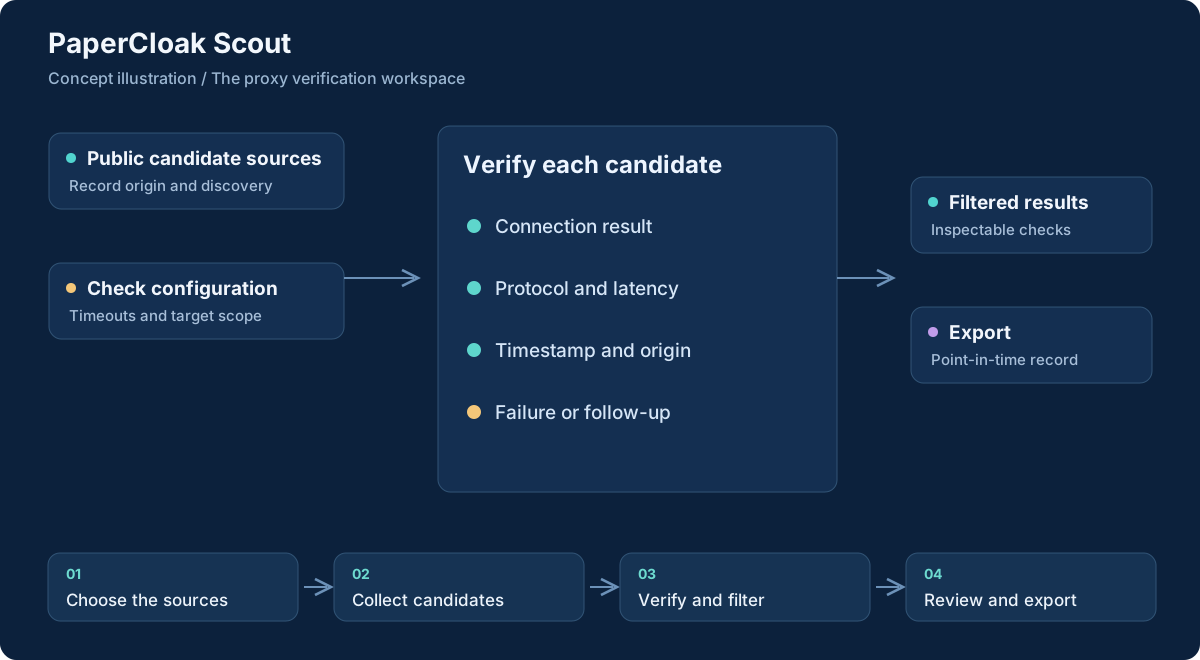
Workflow concept, illustrated. Select the graphic to open it at full size.
From input to useful result
How the work moves through.
01
Choose the sources
Select the public sources, collection scope and relevant filters. Check that the collection is appropriate for the source and intended use.
02
Collect candidates
Normalize endpoint identities, retain contributing sources and keep collection failures visible rather than treating them as successful empty results.
03
Verify and filter
Apply the supported checks, review failure categories and compare results against the required protocol, country and response criteria.
04
Review and export
Inspect check times and source evidence before exporting. Treat a saved result as a dated observation that may need another check.
A concrete example
Compare list quality instead of counting addresses
A developer wants to compare several public lists for a permitted network-testing task. Scout's intended workflow gathers candidates, identifies overlaps and checks the normalized endpoints against the same criteria. A list with thousands of entries may contribute fewer useful results than a smaller source with fresher information.
The valuable output is the explanation behind the remaining endpoints: their contributing sources, check times, supported behavior and recorded failures. The developer can decide whether to recheck or discard them. A successful connection should never be confused with a promise that a public proxy is confidential or trustworthy.
What comes out of the work
Results you can understand.
Normalized candidate sets
Deduplicated endpoints with their contributing source references retained.
Dated check results
Observed responses and failure reasons tied to explicit verification criteria.
Portable result lists
Planned CSV, TXT and JSON outputs for downstream tools and comparison.
Built around
Principles that shape the product.
Configurable collection with retained source provenance
Independent checking and country-resolution boundaries
A reusable core beneath the interface and exports
Connected work
A clear role in the family.
Compass provides a project trail for Scout's own development decisions.
DataQuest has a separate research-orchestration role; any future Scout integration needs an explicit contract.
Worth understanding
Questions and boundaries.
Does Scout sell or operate the proxies?
No. Its role is collecting and checking publicly listed candidates. It is not a proxy provider, a private network or a guarantee of continued endpoint availability.
Is a passing proxy safe for sensitive traffic?
A passing check establishes only the behavior tested at that time. It does not establish operator trust, confidentiality or suitability for credentials and private information.
Is it already the fastest collector?
No comparative performance claim is made here. The development direction calls for representative benchmarks and measured improvements before publishing such conclusions.