Grand Backgrounds JS brings atmospheric motion to website sections and full-page surfaces without requiring a separate rendering integration for every look.
Slow ribbons, shifting light, crystalline patterns or an encounter between galaxies can give a page its own atmosphere. Grand Backgrounds JS offers 21 procedural looks with a common way to configure, pause and remove an effect, keeping the surrounding content central.
Each style has its own module over a shared renderer. Target a page or section, choose a palette and refine movement without importing the entire catalogue. The Start page, configuration guide and workbench provide places to explore a look before integrating it.
What it is designed to do
The capabilities, in detail.
Make expressive procedural backgrounds easy to explore, configure and embed while keeping the surrounding page in control.
Explore a broad visual vocabulary
Liquid Silk, Aurora, Ink Drop, Caustics, Frost, Circuit and Magnetic Fields offer distinct visual treatments. Mosaics, rain, rising embers and galaxy scenes expand the range. Each procedural style has its own defaults, rather than simply recolouring a single effect.
Import the style the page needs
Dedicated effect modules contain their own shader and use the shared renderer. The documented start operation accepts a target element and settings, making section backgrounds possible alongside full-page treatments. A contained target needs a meaningful height. This arrangement keeps the integration focused without making the host application manage every rendering detail.
Refine a look before embedding it
The examples expose settings for palette, speed, density, scale, brightness and related visual choices. Validated configuration travels between the examples through the URL hash. The Start page and guide can produce a complete module-script configuration, while the workbench provides a shareable look. Generated CDN references still depend on the required modules actually being published.
Control the background lifecycle
The documented instance supports option updates, settings snapshots, pause, resume, resize and destruction. Those controls matter when a background belongs to an application view rather than a permanently open demo. The renderer includes hidden-tab handling and context-loss recovery logic; their presence in source is not a claim that every device or browser combination has been validated.
Respect the surrounding experience
WebGL 2 is required for animated rendering in the current implementation. Without it, the documented alternative is a static navy background, not a Canvas animation fallback. Reduced-motion preferences start the effect paused, and pointer influence defaults to zero. Contrast, readability and overall movement still need review within the actual page where the background will appear.
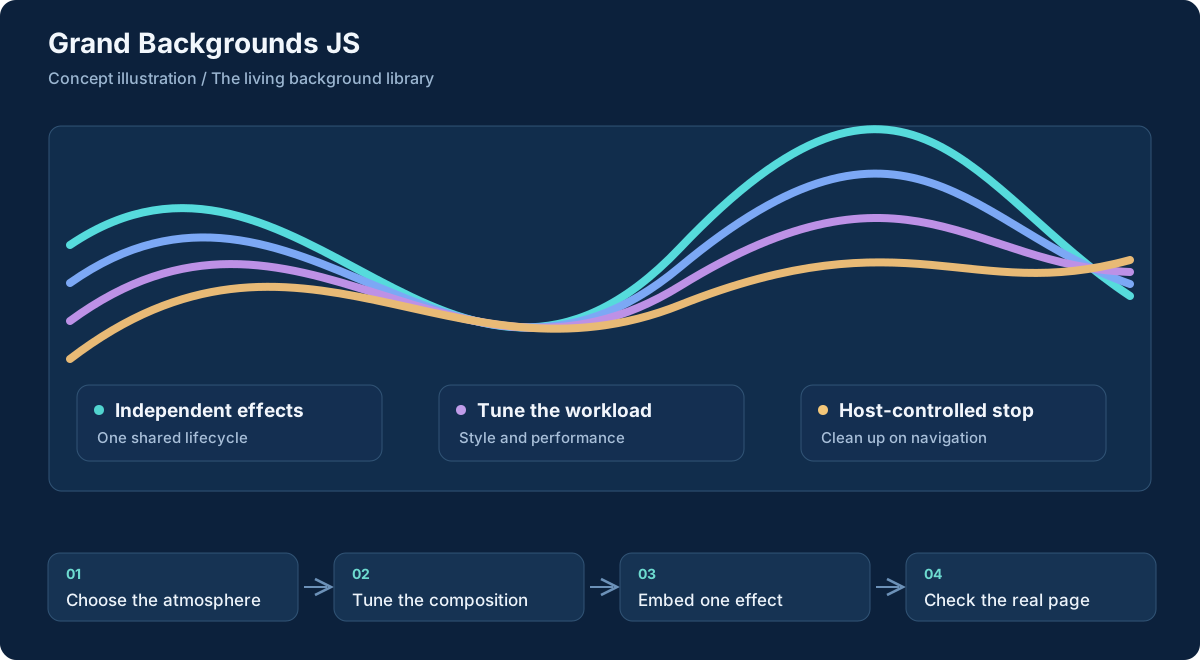
Workflow concept, illustrated. Select the graphic to open it at full size.
From input to useful result
How the work moves through.
01
Choose the atmosphere
Explore styles against the content and choose a look that supports the page's message.
02
Tune the composition
Adjust palette and motion, check contrast and the paused appearance, then retain the configuration.
03
Embed one effect
Use the documented modules, size the target and connect lifecycle controls to the application.
04
Check the real page
Review WebGL support, reduced motion, resizing and cleanup in the target environment. Verify publication before relying on a generated remote import.
A concrete example
A quiet aurora behind a product introduction
A developer wants a product introduction to feel luminous without distracting from its heading and call to action. They explore Aurora, reduce its speed and choose an ocean-oriented palette. The effect is attached to the hero section rather than the entire document, keeping the rest of the page visually calm and making the background's ownership clear.
Before shipping, the developer reviews the paused view, checks text against the brightest area and tests the target browser. Removing the hero should destroy its instance. Module availability and publication state need checking explicitly before adopting a remote import.
What comes out of the work
Results you can understand.
Configured live backgrounds
Procedural motion attached to a deliberate page or section, subject to the current WebGL requirements.
Reproducible settings
Inspectable configuration and example handoffs for refining or rebuilding a selected look.
Focused developer integrations
A chosen effect module and shared lifecycle API, with publication and target-browser checks left explicit.
Built around
Principles that shape the product.
One effect module for each visual style
Shared configuration and lifecycle controls
Interactive examples and configuration handoffs
Connected work
A clear role in the family.
Grand Fireworks JS is the related celebration library with its own implementation and API.
Animations and Flow are adjacent future composition directions, not existing integrations.
Worth understanding
Questions and boundaries.
Does it require a framework?
The library documents module-based JavaScript use without runtime dependencies. Application frameworks can own the target element and call the lifecycle API around it.
Is there animated fallback without WebGL 2?
The inspected implementation uses a static navy fallback. Do not assume Canvas animation or equivalent visual output when WebGL 2 is unavailable.
Can the current example imports be used from a CDN?
Only after verifying that the required modules exist at the chosen published version. The current README explicitly distinguishes local modular work from publication.