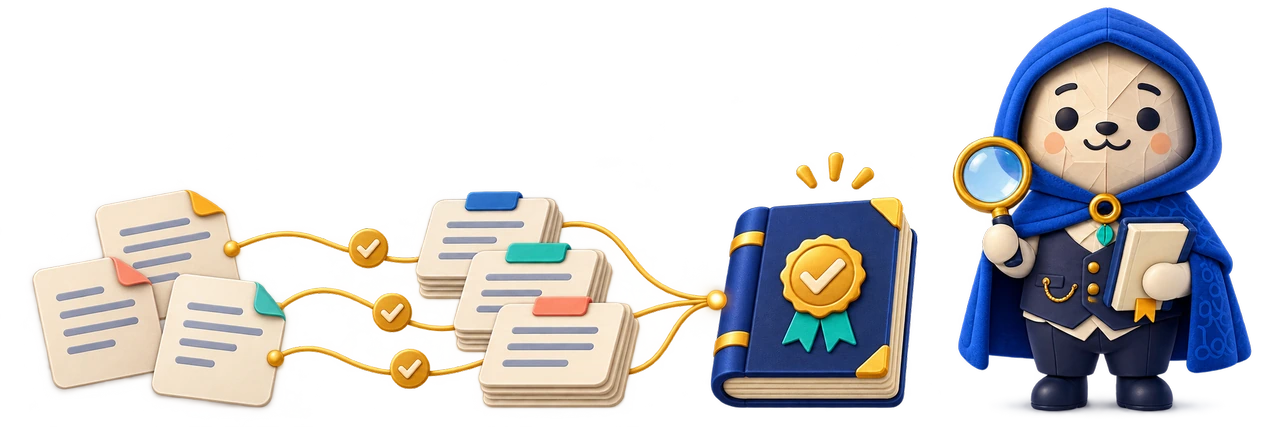
Canon connects discovery, findings, human decisions and guarded changes in a traceable workflow.
Projects accumulate specifications faster than they reconcile them. Requirements survive in old plans; current documents disagree; a prototype overshadows the decision that replaced it. Canon began inside PaperCloak to preserve valuable work while clarifying the current direction.
Canon separates discovering material, recommending a disposition and authorizing a change. Its local implementation collects documentation, records provenance, generates review inputs and requires human decisions before consolidation. The guiding principle is practical: recommendations do not become authority by themselves, and a cleaner folder should not come at the expense of lost knowledge.
What it is designed to do
The capabilities, in detail.
Reconcile overlapping documents while preserving useful ideas and history from older versions.
Collect without rewriting the originals
The collection layer supports Markdown and HTML documents, preserving exact bytes and relative structure in a separate package. Stable path-derived identifiers, sizes and SHA-256 hashes make the inventory checkable. Exact duplicate detection is deterministic; it does not need a model to decide whether two files contain the same bytes.
Turn documents into reviewable findings
The local extractor uses deterministic section and language heuristics to produce structured records and candidate relationships. Findings can point to conflicts, overlap or possible supersession. These signals have false-positive limits and do not amount to reliable understanding of arbitrary prose. Future model-assisted extraction must preserve the same evidence contract.
Keep human judgment explicit
The local browser Review Workbench presents findings with source evidence and non-approving recommendations. A reviewer chooses Keep As-Is, Archive, Changes Required or Needs Discussion. Decisions are separate immutable records; a correction supersedes an earlier decision instead of erasing it. Completing the queue is required before canonical generation.
Create a traceable consolidation package
Canonical generation assembles structured specifications, decision history, unresolved issues, provenance and proposed document actions. The result connects consolidated knowledge to the material and decisions behind it. Revised prose still comes from an external author; Canon can validate and stage approved replacement content rather than pretending to write it autonomously.
Apply changes through a guarded boundary
Application is a separate command and defaults to a dry run. Explicit archive or replacement actions recheck source hashes, preserve earlier versions and record what happened in an append-only registry. A changed source or unstaged revision can block an action instead of being overwritten on the assumption that the audit is still current.
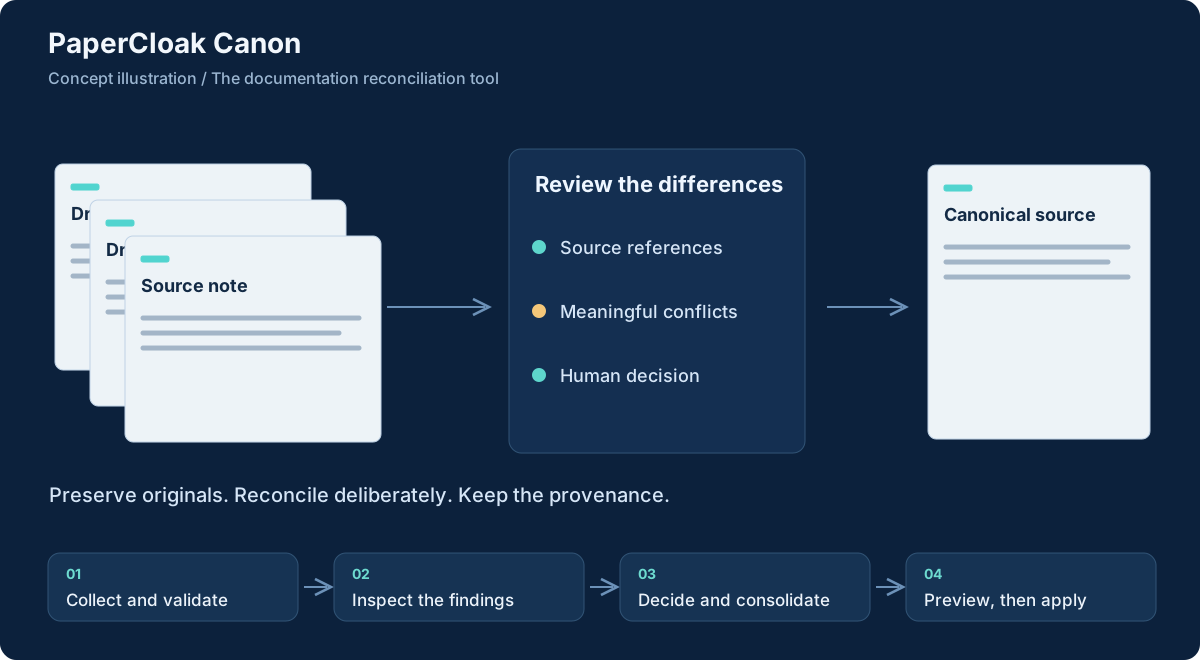
Workflow concept, illustrated. Select the graphic to open it at full size.
From input to useful result
How the work moves through.
01
Collect and validate
Choose a documentation root and separate output location. Build the inventory, preserve sources and verify the collected package before review.
02
Inspect the findings
Run the local heuristic audit and open the Review Workbench. Read the underlying evidence rather than treating a proposed relationship as a conclusion.
03
Decide and consolidate
Give every finding an explicit disposition, generate the canonical package and supply any approved revised content that needs staging.
04
Preview, then apply
Inspect the dry-run action plan. Apply only the intended changes, with hash checks, archival and change records preserving the history.
A concrete example
Reconcile three plans without losing the fourth good idea
A team has an original architecture plan, a later implementation guide and a copied roadmap that still uses an abandoned product name. An older note also contains one useful requirement absent from the newer documents. Collecting everything first makes it possible to inspect overlap without deleting the inconvenient parts.
The reviewer decides which direction is authoritative, retains the unique requirement and requests a revision to the misleading guide. Canon packages those decisions and stages the authored replacement. A later dry run detects any source changes before application, while the archived version and registry explain what was replaced and why.
What comes out of the work
Results you can understand.
Validated source inventories
Document identities, exact duplicates and preserved sources.
Reviewed canonical packages
Structured consolidation tied to source records, human decisions and unresolved questions.
Auditable change history
Archive and replacement records connecting approved actions to the versions they affected.
Built around
Principles that shape the product.
Read-only collection and source provenance
Explicit human review of structured findings
Validated packages and guarded archive or replacement
Connected work
A clear role in the family.
Ink can author the documents Canon inventories and reconciles.
Compass keeps project context; Canon addresses authority, duplication and drift within the documentation itself.
Worth understanding
Questions and boundaries.
Does Canon require an AI provider?
The current local pipeline does not. Its extraction and analysis are deterministic heuristics; model-based interpretation remains a separate direction.
Will it decide which document is true?
It supplies evidence and review inputs. Organizational authority and material dispositions remain human decisions.
Does it support Office files and hosted teams?
The current collection scope is Markdown and HTML. Broader document formats, hosted operation and multi-user authentication are not established capabilities.