Animations is intended to connect effects, timing, layers and export through one coherent foundation, so a polished visual moment can outlive the editor that created it.
Rings, reveals, atmospheric backgrounds and fireworks behave differently, yet all need clocks, positioning, rendering and cleanup. Animations proposes a shared foundation for those responsibilities, with each effect retaining its own identity and creative controls. A specialized fireworks engine alone cannot establish that broader foundation.
A scene would describe its frame, layers, timing, palette and accessibility choices. A runtime would interpret it; Studio would offer visual editing. Separating these responsibilities should let a project travel beyond one editor without requiring creators to manage renderer internals.
What it is designed to do
The capabilities, in detail.
Design with visual intent while a shared runtime handles timing, framing and effect coordination.
Give effects one shared lifecycle
The proposed runtime owns initialization, timing, resize behavior and disposal. Effects should use that lifecycle instead of creating competing clocks or hidden rendering loops. Clear ownership helps coordinate layers, pause previews and release resources when a component disappears.
Compose independent effect families
Fireworks, rings, particles, reveals and atmospheres are candidate packages around the same foundation. Each would define its visual behavior, configuration and appropriate alternatives. Fireworks-specific ideas such as shells and finales belong in that package, rather than becoming assumptions imposed on every other effect or on the overall scene format.
Coordinate frames and rendering
The architecture direction includes a Canvas baseline, WebGL enhancement and consistent coordinate spaces for contained and full-screen output. Responsive framing, crop decisions and safe areas should belong to the scene model. These are design requirements still to prove across effects, not a guarantee of identical rendering on every device or browser.
Treat accessibility as scene behavior
Reduced motion, static substitutions, low-flash choices and sound preferences should remain attached to the creative work. Adaptive quality and explicit limits would help prevent one ambitious effect from overwhelming the page. The proposed runtime needs to explain what it can render and what alternative it has selected when an expressive treatment is unsuitable.
Preserve portable, inspectable projects
A versioned scene would hold output dimensions, ordered layers, motion settings and declared assets. Planned validation and migration rules should make imports predictable, while export hooks could support browser packages and later capture workflows. Framework wrappers and media publishing remain staged extensions; they should not become prerequisites for understanding or using the underlying project.
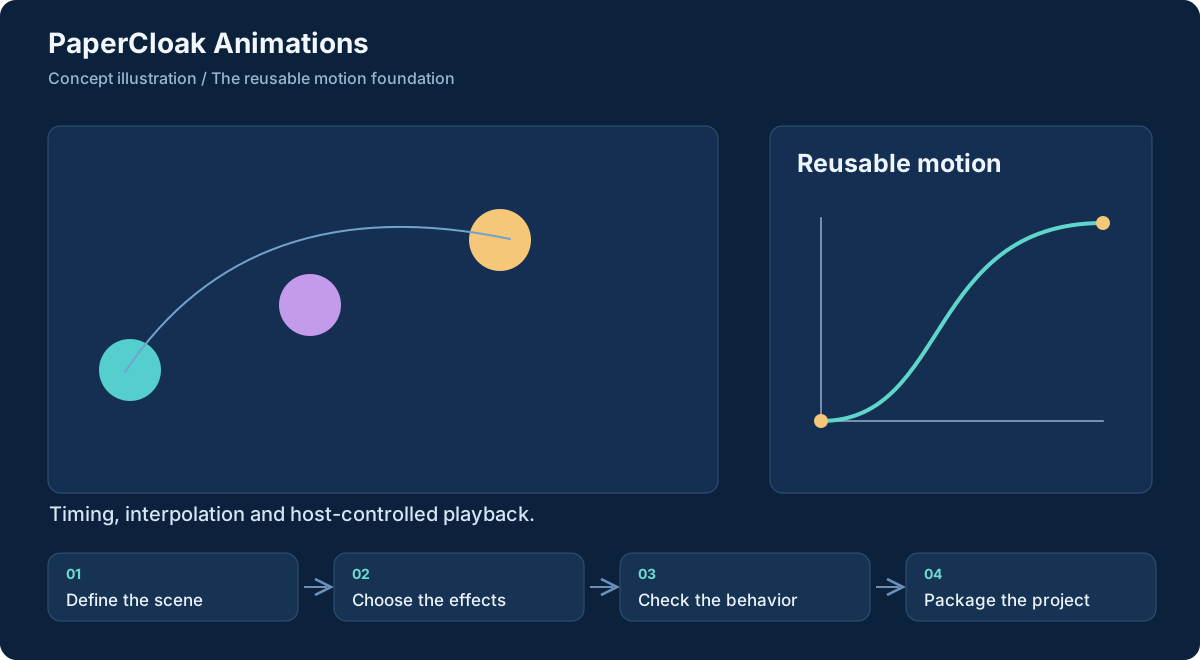
Workflow concept, illustrated. Select the graphic to open it at full size.
From input to useful result
How the work moves through.
01
Define the scene
Describe the frame, visual intent and destination independently of the authoring interface.
02
Choose the effects
Combine effect families with explicit settings, layer order and shared lifecycle conventions.
03
Check the behavior
Review timing, performance, resizing and accessible alternatives beyond the design preview.
04
Package the project
The intended delivery preserves the scene and declared assets alongside the chosen runtime output. Validate the actual integration before treating it as production-ready.
A concrete example
A celebration that belongs to the surrounding application
Imagine an application that acknowledges a completed milestone with a brief reveal, a ring and a small fireworks layer. Those effects need to start together, respect the available container and stop cleanly when the view changes. The proposed Animations foundation gives them shared timing and lifecycle behavior while leaving each effect's appearance independently configurable.
Studio could shape the scene visually, with the developer inspecting its integration and reduced-motion alternative. This is the intended benefit, but the common runtime and cross-effect contracts still need implementation and demonstration before the workflow can be offered dependably.
What comes out of the work
Results you can understand.
Versioned scene definitions
The intended portable description of frames, effects, timing and declared creative assets.
Reusable effect compositions
Planned combinations that can be revised without rebuilding an entire visual moment from scratch.
Runtime-oriented handoffs
A proposed delivery boundary between the editable scene, its implementation and the application that embeds it.
Built around
Principles that shape the product.
Shared scene and lifecycle contracts
Independent effect packages
Versioned portable projects
Connected work
A clear role in the family.
Animation Studio would provide the visual authoring experience over the runtime.
Grand Fireworks JS is a separate reference implementation, not an automatic compatibility promise.
Worth understanding
Questions and boundaries.
Does this replace Grand Fireworks JS?
No. Grand Fireworks remains a separate library and reference. Selective migration is a design direction, with no automatic promise of API compatibility or feature parity.
Is the proposed effect API ready to adopt?
No. Lifecycle sketches describe architectural intent. They need validation with different effects before becoming a stable developer contract.
Will every creator need to understand the engine?
Studio is intended to hide routine animation mathematics behind visual controls. Developers should still have a clear, inspectable runtime boundary when they need deeper integration.