Grand Fireworks JS supplies expressive browser effects while the host application stays in charge of the occasion.
Grand Fireworks began with a very particular creative need: a fireworks display worthy of Joely's song. The available effects did not have the depth and character Travis wanted, so the small visual request grew into a reusable JavaScript library and a much more deliberate documentation and demo experience.
The library combines programmable pyrotechnics with a WebGL-first renderer, persistent trails, bloom, shell geometry and synthesized sound. It can decorate a contained moment, respond to interaction or form part of a timed show. The effect remains independent of the PaperCloak document tools, even where Flow may use it as a provider.
What it is designed to do
The capabilities, in detail.
Build a fireworks display worthy of a personal creative moment, then make the effect and its documentation useful to other developers.
A richer firework appearance
The documented renderer includes long-exposure trails, bright star cores, rocket exhaust, explosion flashes, bloom and secondary crackles. Different shell geometries and grouped salvos give a display more variety than a repeated spray of identical dots. The right configuration still depends on the scene.
A rendering path suited to the browser
WebGL2 is the primary renderer, with a Canvas 2D fallback. Performance presets let an integration choose an appropriate workload, and the package includes hidden-tab pause behavior. Particle counts and frame-rate aims are configuration targets, not guarantees for every device.
Interaction, timing and a deliberate finale
Pointer launches, contained or fullscreen placement, graceful stopping, timed shows and finales are part of the documented library. Host-driven rendering supports custom scenes and games. These controls help an application own the occasion instead of simply placing an endless animation over its interface.
Text and sound as part of the moment
The library includes multi-line hybrid text fireworks and procedural launch, whistle, boom and crackle sounds. Those capabilities should be integrated with the site's audio and accessibility choices. A celebration is more useful when the surrounding application still controls when it begins and ends.
A workbench that helps developers learn
The interactive guide and workbench connect configuration to a visible show. First-party TypeScript declarations and a zero-runtime-dependency core support integration without requiring a framework-specific wrapper. Examples and a configurable preview make it easier to move from an attractive demo to an intentional implementation.
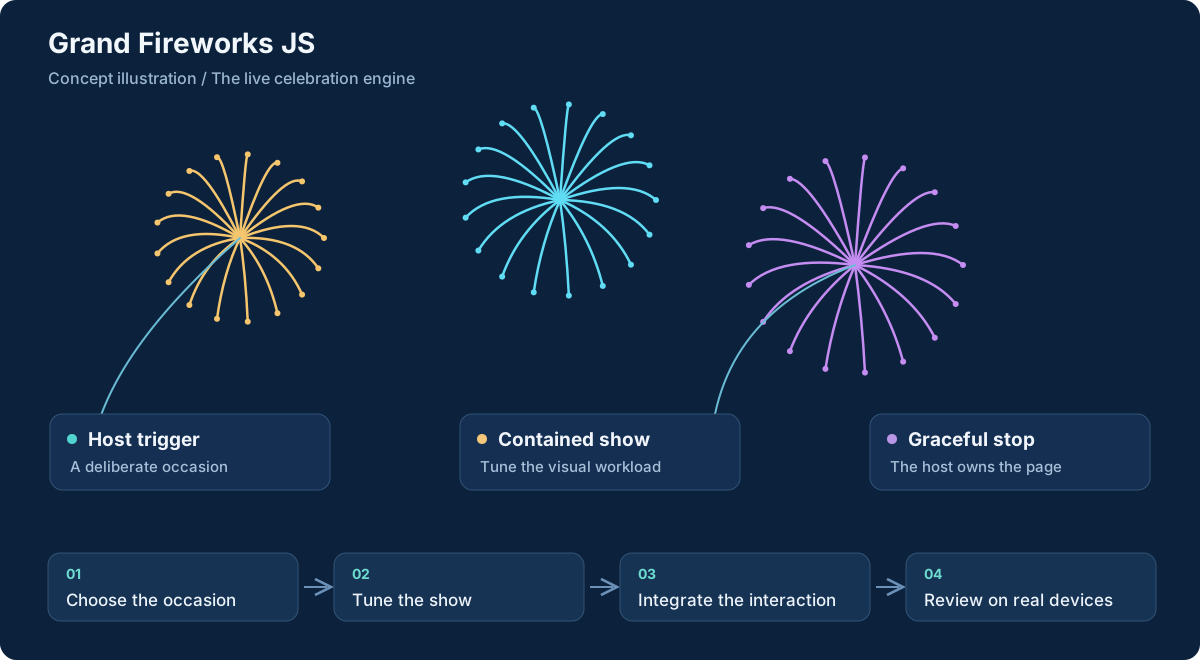
Workflow concept, illustrated. Select the graphic to open it at full size.
From input to useful result
How the work moves through.
01
Choose the occasion
Decide whether the effect belongs in a contained panel, a fullscreen moment or a custom rendering host.
02
Tune the show
Use the demo and workbench to explore shell types, colours, timing and an appropriate performance preset.
03
Integrate the interaction
Connect launches, sound and stopping behavior to the application's deliberate triggers.
04
Review on real devices
Inspect performance, readability and reduced-motion expectations in the actual page context.
A concrete example
A celebration that belongs to the page
A developer wants to celebrate a completed creative task. Instead of running fireworks continuously, the application triggers a short display in the right region, uses a restrained palette and stops gracefully when the moment is over.
For a presentation or event, the same library can support a more elaborate timed show, text moment or finale. The important decision is how the effect serves the experience. The library supplies the visual and programmatic pieces; the host remains responsible for the page and its audience.
What comes out of the work
Results you can understand.
Live browser effects
Programmable fireworks integrated with an actual page or scene.
Reusable show configurations
Deliberate choices for colour, shell behavior, timing and performance.
Presentation-ready moments
An effects provider that can support a larger sequence without owning its authoring workflow.
Built around
Principles that shape the product.
WebGL2 rendering with a Canvas 2D fallback
A framework-free core with zero runtime dependencies
Deliberate host controls for timing, sound and stopping
Connected work
A clear role in the family.
Flow can use Grand Fireworks as an independent effects provider.
Ink can hold the narrative and documentation around a creative project.
Worth understanding
Questions and boundaries.
Is this part of the Ink editor?
No. Grand Fireworks JS is a separately usable library. Related PaperCloak tools can integrate it through a defined boundary.
Does it need a framework?
The documented core is framework free with zero runtime dependencies. Framework integrations still need to respect their host lifecycle.
Will a high preset perform identically everywhere?
No. Device capability, rendering context and workload affect the result. Choose a preset and inspect the actual experience on the devices that matter.